Anker SOLIX F2000 vs AFERIY P280 (2026)
Bottom Line
The AFERIY P280 beats the Anker F2000 on almost every measurable spec — more output power, higher surge, faster charging, bigger expansion path, longer warranty — at a lower price. The F2000 fights back with Anker brand trust, a proven app, and wheels that make 67 lbs somewhat manageable. Unless brand loyalty is your primary buying criterion, the P280 is the stronger buy in early 2026.
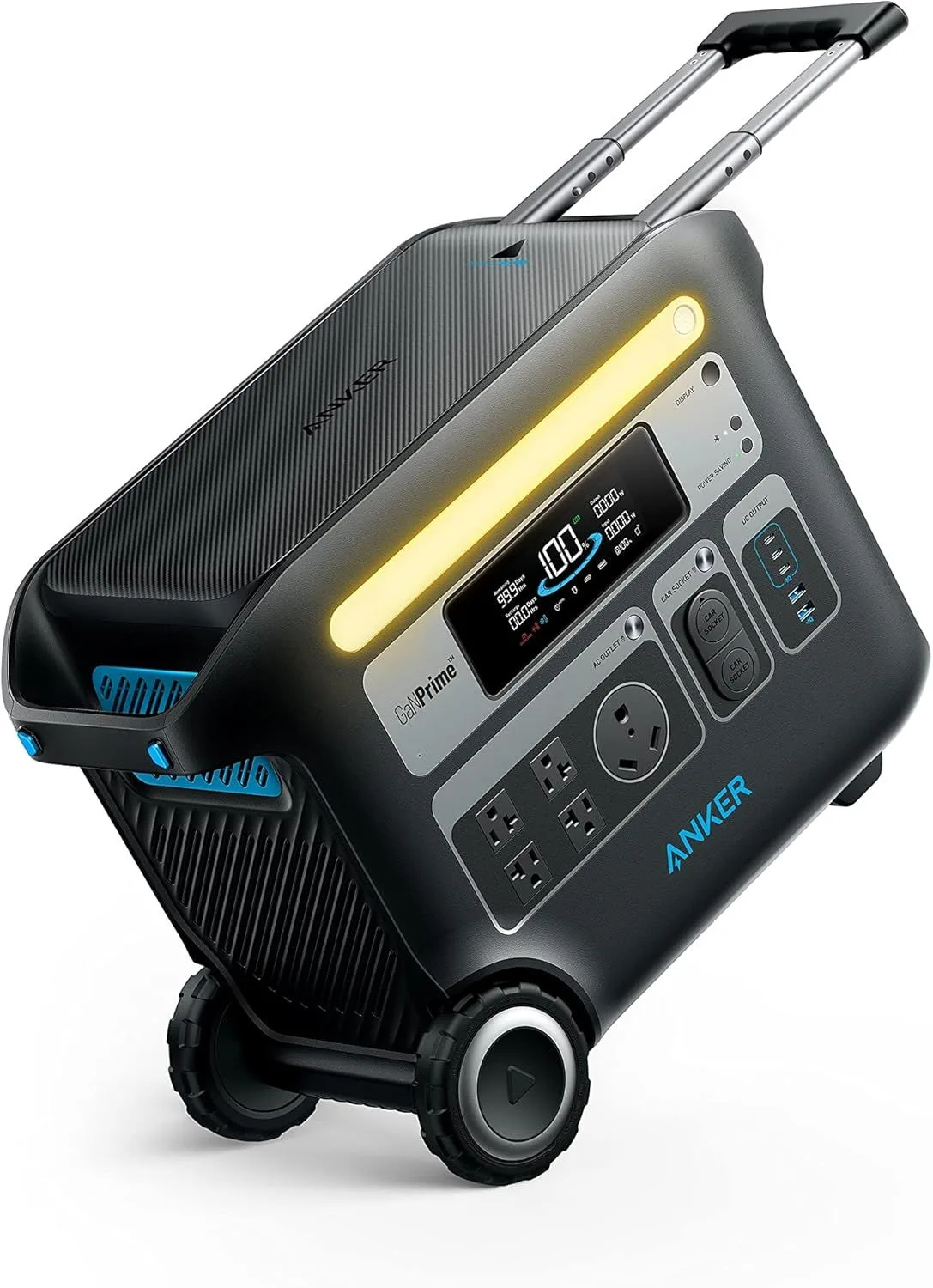
Anker SOLIX F2000
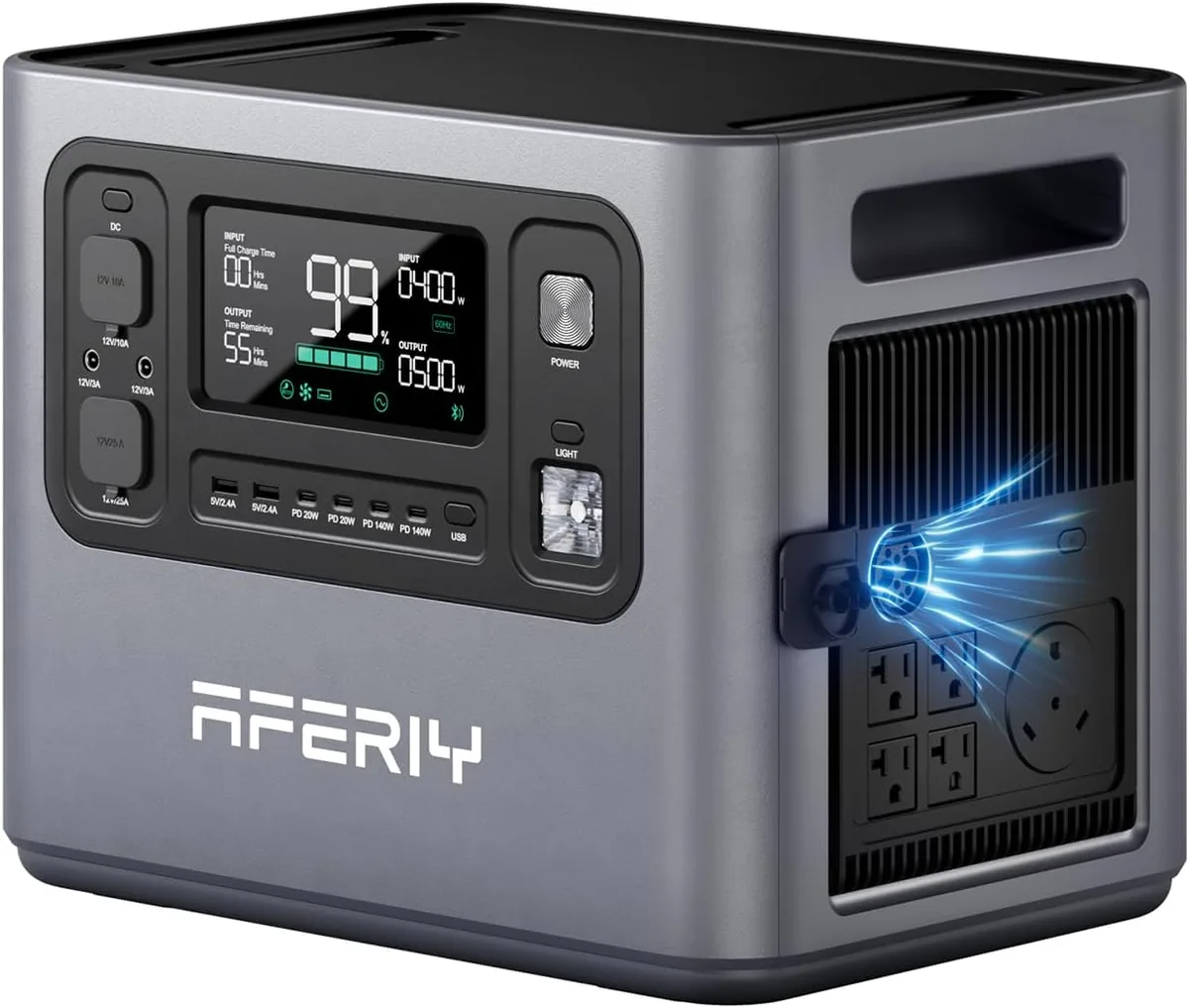
AFERIY P280
Legacy Brand vs Spec-Sheet Challenger
The Anker SOLIX F2000 was a top-tier pick when it launched. GearJunkie said it "could effectively replace the electrical system in a van." But the portable power market moves fast, and newer entrants like the AFERIY P280 have undercut the F2000 on price while surpassing it on nearly every spec.
Both pack 2,048Wh LiFePO4 batteries. That is where the similarities end. The P280 outputs 2,800W continuous versus 2,400W, surges to 5,600W versus 2,400W, charges faster, weighs 20 lbs less, accepts more solar input, and expands to 10,240Wh versus 4,096Wh. The F2000 counters with Anker's brand heritage, a polished app, GaN cooling tech, and built-in wheels with a retractable handle.
The pricing tells an interesting story. The F2000 sits at top-tier investment while the P280 comes in at top-tier investment — making the AFERIY modestly more expensive. That gap is wide enough to fund a 200W solar panel or an extra expansion battery. The F2000 was competitive at its original launch price, but the market has moved underneath it. Anker's own C2000 Gen 2 is the clearest evidence — it replaced the F2000 in the lineup with a unit that weighs 25 lbs less, charges faster, and surges to 4,000W. The F2000 still works fine, but it is no longer the best value proposition from its own brand.
| Feature | Anker SOLIX F2000 (PowerHouse 767) Portable Power Station | AFERIY P280 Portable Power Station |
|---|---|---|
| Price Range | $500+ | $500+ |
| Battery Capacity | 2,048Wh | — |
| Battery Type | LiFePO4 (GaN) | — |
| Output Power | 2,400W | 2,800W continuous |
| Surge Power | 2,400W | 5,600W peak |
| Weight | 67.2 lbs | 47.6 lbs (21.6 kg) |
| Solar Input | 1,000W max | 1,200W max (dual MPPT) |
| Check Price | Check Price |
AFERIY Wins Inverter Power and Surge Capacity
The AFERIY P280's 2,800W continuous / 5,600W surge inverter is the highest in the entire 2kWh class. The F2000's 2,400W rating is respectable — but critically, its surge is also capped at 2,400W. That zero headroom for inrush current is the F2000's biggest weakness.
A typical RV air conditioner draws 3,000-3,500W during compressor startup. The P280 handles it. The F2000 trips its protection circuit. A circular saw draws 2,400-4,000W on startup. The P280 absorbs it without blinking. The F2000 may or may not cope, depending on the specific tool. This is not a marginal difference — it determines which appliances you can and cannot run.
The real-world impact goes beyond individual appliances. Running multiple devices simultaneously — a microwave (1,200W) plus a hair dryer (1,500W) — pushes past the F2000's 2,400W ceiling entirely. The P280 handles that 2,700W combined load within its continuous rating. For RV owners running a kitchen appliance while the AC cycles on, or contractors running two power tools on the same circuit, the P280's 400W output advantage and 3,200W surge headroom translate into fewer tripped breakers and less frustration.
Consider a concrete job-site scenario. A contractor running a 10-inch miter saw (1,800W rated, ~3,200W startup) while a battery charger (200W) and work lights (100W) stay connected. The combined baseline is 2,100W continuous with 3,200W inrush spikes every time the saw blade engages. The P280's 5,600W surge absorbs the saw startup without interrupting the other devices. The F2000's matched 2,400W surge/continuous rating means the saw startup alone exceeds the surge ceiling — the protection circuit trips, and every connected device loses power simultaneously.
Anker Wins Software, App, and Smart Features
Anker's app is one of the best in portable power. WiFi and Bluetooth connectivity, real-time monitoring, smart power management that auto-disconnects devices when batteries are full, and a polished interface that just works. StorageReview called the F2000 "more than just a power station — it's a comprehensive solution."
The AFERIY P280 uses a third-party app called Bright EMS. NotebookCheck reported "massive problems" with the iOS version — connection failures, unreliable readings, and a general lack of polish. The Android version works adequately but feels utilitarian compared to Anker's native app. If you rely on app monitoring for home backup management, this gap matters daily.
The app difference has practical consequences beyond convenience. Anker's app lets you set charging schedules, configure UPS switchover behavior, and monitor real-time power flow to every connected device from your phone. If the unit sits in a garage or basement, you check its status without walking to it. The P280's Bright EMS provides basic monitoring when the Bluetooth connection cooperates, but lacks the scheduling and automation features that make the F2000 a "set and forget" home backup. For users who treat their power station as a permanent home appliance rather than a camping accessory, the F2000's software ecosystem is its strongest remaining advantage over the P280.
AFERIY Wins Charging Speed and Solar Input
The P280 charges from empty to 80% in just 38 minutes via its 1,800W AC input — full charge in about 55 minutes. The F2000 reaches 80% in roughly 84 minutes via its 2,200W input. Despite the F2000's higher AC wattage on paper, AFERIY's charging circuitry is more aggressive, and the P280 also supports simultaneous AC and solar charging — the F2000 does not.
That 29-minute gap to 80% (38 vs 84 minutes) creates real differences during intermittent power situations. During rolling blackouts with 90-minute power windows, the P280 reaches full charge with 35 minutes to spare. The F2000 barely crosses 80% before the grid drops again. Over three blackout cycles in a single day, that gap compounds — the P280 stays topped off while the F2000 never quite catches up. For hurricane-season preparedness, the faster charging station is the one that keeps your food cold through multi-day grid instability.
The solar gap is even wider. The P280 accepts 1,200W through dual MPPT controllers with two independent solar input ports. The F2000 maxes out at 1,000W through a single XT-60 port. On a clear day with a large panel array, the P280 can achieve full solar recharge in about 2 hours — the F2000 needs 2-3 hours even under ideal conditions.
The dual MPPT controller design on the P280 is a practical advantage beyond raw wattage. Two independent solar inputs mean you can run two panel strings at different angles — one facing east for morning sun, one facing west for afternoon — without either string dragging down the other's efficiency. The F2000's single XT-60 input runs all panels through one controller, which means a partially shaded panel reduces output for the entire array. For permanent installations where panel placement is fixed, the P280's dual-input architecture extracts more energy from imperfect conditions.
The Weight Problem: 67 lbs vs 48 lbs
The F2000 weighs 67.2 lbs — the heaviest unit relative to capacity in the entire high-capacity class. Anker mitigated this with wheels and a retractable handle, and credit where it's due: that wheeled design works well on flat surfaces. Roll it from the garage to the patio. Wheel it across a parking lot. The EasyTow system is well-engineered.
But wheels don't help when you need to lift the unit into a truck bed, up a flight of stairs, or onto a table. At 67 lbs, that requires two people. The P280 at 47.6 lbs is still heavy, but one strong adult can manage it with the dual side handles. Neither station is something you casually toss in a backpack — but the 20-lb difference changes how often you're willing to move it.
The weight-to-capacity ratio tells the fuller story. The F2000 delivers 30.5Wh per pound — among the worst in its class. The P280 delivers 43.0Wh per pound — nearly 40% more energy per pound of metal you carry. For comparison, the Anker C2000 Gen 2 hits 49.1Wh per pound. The F2000's weight penalty is real, and it stacks up every time you load the unit for a camping trip, carry it down basement stairs for storm prep, or wrestle it into the back seat of a sedan. The P280 is not "light" by any stretch, but 48 lbs with two grab handles is a one-person job. Sixty-seven pounds with wheels still requires a second set of hands for any lift.
AFERIY Wins Expandability: 10,240Wh vs 4,096Wh
Both stations support expansion batteries, but the scale differs enormously. The F2000 adds one expansion battery for 4,096Wh total — doubling the base capacity. The P280 accepts up to 4 expansion batteries, reaching 10,240Wh — roughly five times the base capacity.
TechRadar noted the P280's expansion path "shifts the unit from portable power station towards modular home energy backup territory." A fully expanded P280 system at 10kWh rivals dedicated home battery systems at a fraction of the cost. If you are building incrementally — starting portable and growing into whole-home backup — the P280's expansion architecture has no equal in this price range.
The practical difference shows up in outage planning. A base P280 at 2,048Wh covers an 8-12 hour outage running a fridge, router, and lights. Add one expansion battery and you cover a full 24 hours. Add two more and you are looking at multi-day autonomy without solar. The F2000 maxes out at 4,096Wh — adequate for a 24-hour outage but with no further growth path. For hurricane-prone or wildfire-risk areas where multi-day grid failures are realistic, the P280's ability to scale to 10kWh is the more future-proof investment.
Warranty and Brand Trust
The AFERIY P280 offers a 7-year warranty (2 standard plus 5 extended with registration) — the longest in the 2kWh class. The Anker F2000 provides 5 years. On numbers alone, AFERIY wins.
But warranty length is only half the equation. Anker has operated in the US market for over a decade with established customer service, easy returns, and a track record across millions of products. AFERIY is newer with less service history in North America. A 7-year warranty from a brand that is still building its support infrastructure carries a different weight than a 5-year warranty from a brand you have probably already used for phone chargers and USB cables.
Think about what happens in year four. The inverter board on either unit starts showing a fault code. With Anker, you call a US-based support line, reference your order, and receive a replacement unit or board within a week — the process is documented across thousands of customer interactions. With AFERIY, the warranty is valid but the path to resolution is less predictable. The brand may have excellent support by then, or it may not. You are placing a bet on the company's trajectory, not its current track record. For buyers who treat a power station as a long-term infrastructure investment, that uncertainty carries real weight.
Cycle life is another long-term factor. Both use LiFePO4 chemistry rated for 3,000+ cycles to 80% capacity. At one full cycle per day, that is over 8 years before noticeable degradation. Most home backup users cycle their station far less — maybe 5-10 full cycles per month during storm season and near zero during calm months. At that rate, the cells outlast everything else in the chassis. The practical lifespan of either unit depends less on the battery chemistry and more on whether the inverter, BMS, and charging circuitry hold up — and that is where Anker's longer track record and available replacement parts provide an edge that no warranty document fully captures.
Port Layout and Day-to-Day Connectivity
The P280 provides 4 AC outlets, 4 USB-A ports, and 2 USB-C ports. The F2000 carries 6 AC outlets, 4 USB-A ports, and 2 USB-C ports (one at 100W). On AC outlet count alone, the F2000 wins by two — a practical advantage if you run multiple AC appliances without a power strip.
The F2000's 100W USB-C port is a quiet standout. It charges a MacBook Pro at full speed directly from the station, bypassing the AC inverter entirely. That matters for efficiency — USB-C PD charging skips the DC-to-AC-to-DC conversion loss that occurs when a laptop's own AC adapter plugs into an AC outlet. You extract roughly 10-15% more usable energy from the battery this way. The P280's USB-C ports top out at lower wattage, so laptop charging typically goes through the AC inverter with its associated conversion losses.
Who Should Get Which?
Get the AFERIY P280 if you:
- Run high-draw appliances. The P280's 2,800W continuous and 5,600W surge handles RV air conditioners, power tools, and multi-appliance loads that trip the F2000's protection circuit. If your appliance list includes anything above 2,400W, the P280 is the only option here.
- Want to build a modular home backup. Four expansion battery slots reaching 10,240Wh gives you a growth path that the F2000 (limited to one expansion, 4,096Wh total) cannot match. Start with the base unit and add batteries as your budget allows.
- Prioritize solar charging. Dual MPPT controllers accepting 1,200W across two independent ports outperform the F2000's single 1,000W input. If solar is your primary charging method, the P280 harvests more energy in less time.
- Need to carry your station. At 47.6 lbs versus 67.2 lbs, the P280 is 20 lbs lighter. That is the difference between one-person and two-person lifting for most adults. No wheels required when you can carry it with both hands.
Get the Anker F2000 if you:
- Value app-based monitoring and control. Anker's native app is reliable on both iOS and Android with real-time stats, smart power management, and auto-disconnect features. AFERIY's third-party Bright EMS app has documented iOS issues and lacks polish.
- Roll your station across flat surfaces frequently. The F2000's EasyTow wheels and retractable handle are well-engineered. If your use case involves moving the station across garages, driveways, or campground lots rather than lifting it, the wheeled design earns its weight.
- Trust established brands. Anker has sold millions of products in North America with proven customer service. If a 5-year warranty from a known brand matters more than a 7-year warranty from a newer name, the F2000 buys peace of mind.
- Run loads under 2,000W in quiet environments. The F2000's GaN inverter runs cooler with less fan noise at moderate loads. For powering a home office, CPAP machine, or bedroom electronics where silence matters, the F2000's quieter operation is a real benefit.
Common Questions
Why is the AFERIY P280 cheaper than the Anker F2000 despite better specs?
AFERIY is a newer brand spending less on marketing, retail distribution, and brand premium. The P280 uses quality LiFePO4 cells and offers a 7-year warranty, but you are trading Anker's established customer service infrastructure and years of portable power track record for raw specs-per-dollar value. Whether that trade-off works depends on how much brand trust matters to you.
Can the AFERIY P280 run an RV air conditioner?
Yes. The P280's 2,800W continuous / 5,600W surge easily handles RV AC compressor startup (typically 3,000-3,500W inrush). The Anker F2000 cannot — its surge is capped at 2,400W, the same as continuous, which means compressor startups often trip the protection circuit.
Which has a better app?
The Anker F2000, by a wide margin. Anker's app provides reliable WiFi and Bluetooth control, smart power management, and auto-disconnect features. The AFERIY P280 uses a third-party app (Bright EMS) with documented iOS connectivity problems — NotebookCheck reported "massive problems" with the iOS version. Android works adequately but lacks the polish of Anker's native solution.
Can I expand both stations with extra batteries?
Both support expansion. The Anker F2000 adds one expansion battery for 4,096Wh total. The AFERIY P280 accepts up to 4 expansion batteries for a massive 10,240Wh — roughly 5x the base capacity. For building a modular home backup system, the P280's expansion path is far more flexible.
How do the warranties compare?
The AFERIY P280 offers up to 7 years (2 standard plus 5 extended with product registration), while the Anker F2000 provides 5 years full-device coverage. On paper, AFERIY wins. In practice, Anker has years of US-based support infrastructure behind their warranty — making it arguably easier to exercise if something goes wrong.
Should I buy either of these or get the Anker C2000 Gen 2 instead?
If budget allows, the Anker C2000 Gen 2 outperforms the F2000 in every dimension — 25 lbs lighter, faster charging, 4,000W surge, ultra-low 9W idle draw. It essentially made the F2000 obsolete. The AFERIY P280 still competes with the C2000 Gen 2 on raw power (2,800W vs 2,400W) and price, so the P280 vs C2000 Gen 2 is a more interesting matchup for most buyers.
How loud are these stations under load?
The Anker F2000 uses GaN (gallium nitride) inverter technology that runs cooler than traditional MOSFET designs, meaning its fans kick in less often and at lower speeds. Under moderate loads (500-1,000W), the F2000 is noticeably quieter. The AFERIY P280 runs fans more aggressively under sustained load, and several Amazon reviewers noted audible fan noise above 1,500W continuous draw. Neither unit is silent, but the F2000 has a measurable noise advantage.
Can I use the AFERIY P280 for a home UPS setup?
The P280 supports UPS (uninterruptible power supply) mode with a switchover time under 20ms — fast enough for computers and networking equipment to stay running during a power transition. The Anker F2000 also supports UPS mode with a 20ms switchover. Both work as emergency computer backup, but the P280's higher surge capacity gives it more headroom for unexpected load spikes during the transition.
Which is better for off-grid solar setups?
The AFERIY P280 is the stronger solar platform. Its dual MPPT controllers accept 1,200W of solar input through two independent ports, allowing you to run two separate panel strings optimized for different angles or conditions. The F2000's single XT-60 port caps at 1,000W. For a permanent off-grid cabin or RV with a dedicated solar array, the P280 charges faster and handles more panels.
Which 2kWh Station Fits Your Priorities?
The AFERIY P280 wins this comparison on measurable specs: more output power, higher surge, faster charging, lighter weight, bigger expansion path, and a longer warranty — all at a lower price. For buyers who prioritize performance per dollar, the P280 is the clear pick.
The Anker F2000 earns its spot for buyers who value the intangibles: a polished app ecosystem, quieter GaN inverter technology, wheeled portability on flat surfaces, and the confidence of buying from a brand with a decade of US market presence. Those intangibles cost a premium — and in this case, the premium also buys less output power, less expansion, and more weight.
For the buyer trying to power a home office through storm season, the F2000's quiet GaN inverter and reliable app monitoring make it livable as an always-on backup sitting behind a desk. For the buyer assembling a modular off-grid system — starting with the base unit and adding expansion batteries and solar panels over time — the P280's higher output ceiling, dual solar inputs, and 10,240Wh expansion path make it the foundation that scales. The use cases are different enough that both stations find their audience despite the spec-sheet gap.
One more thing: if you are leaning toward Anker, check the Anker C2000 Gen 2 before buying the F2000. It outperforms the F2000 on every metric — 25 lbs lighter, faster charging, 4,000W surge, 9W idle draw — and has effectively replaced the F2000 in Anker's lineup. The F2000 is a good station that was great in its era. The P280 and the C2000 Gen 2 represent where the market has moved.