Anker SOLIX C300 vs BLUETTI Elite 30 V2: Two Premium Compacts, One Clear Winner on Power
Same 288Wh LiFePO4 battery. Same 3,000+ cycle lifespan. Same 5-year warranty. Same 140W USB-C. These two compact power stations share more DNA than any other pair in the category. But the BLUETTI Elite 30 V2 delivers double the output wattage for less money, while the Anker SOLIX C300 bundles a solar panel and operates at a whisper-quiet 25dB.
Which premium compact actually earns its price? We break down every difference that matters.
The BLUETTI Elite 30 V2 delivers more power per dollar — but the Anker wins specific use cases.
For most buyers, the BLUETTI Elite 30 V2 is the stronger value. Double the output wattage (600W vs 300W), Power Lifting to 1,500W, faster turbo charging, and UPS functionality — all at a lower price point. But the Anker SOLIX C300 is the better choice for two specific audiences: CPAP users who need 25dB silence, and buyers who want a bundled solar panel from a trusted brand without compatibility headaches.
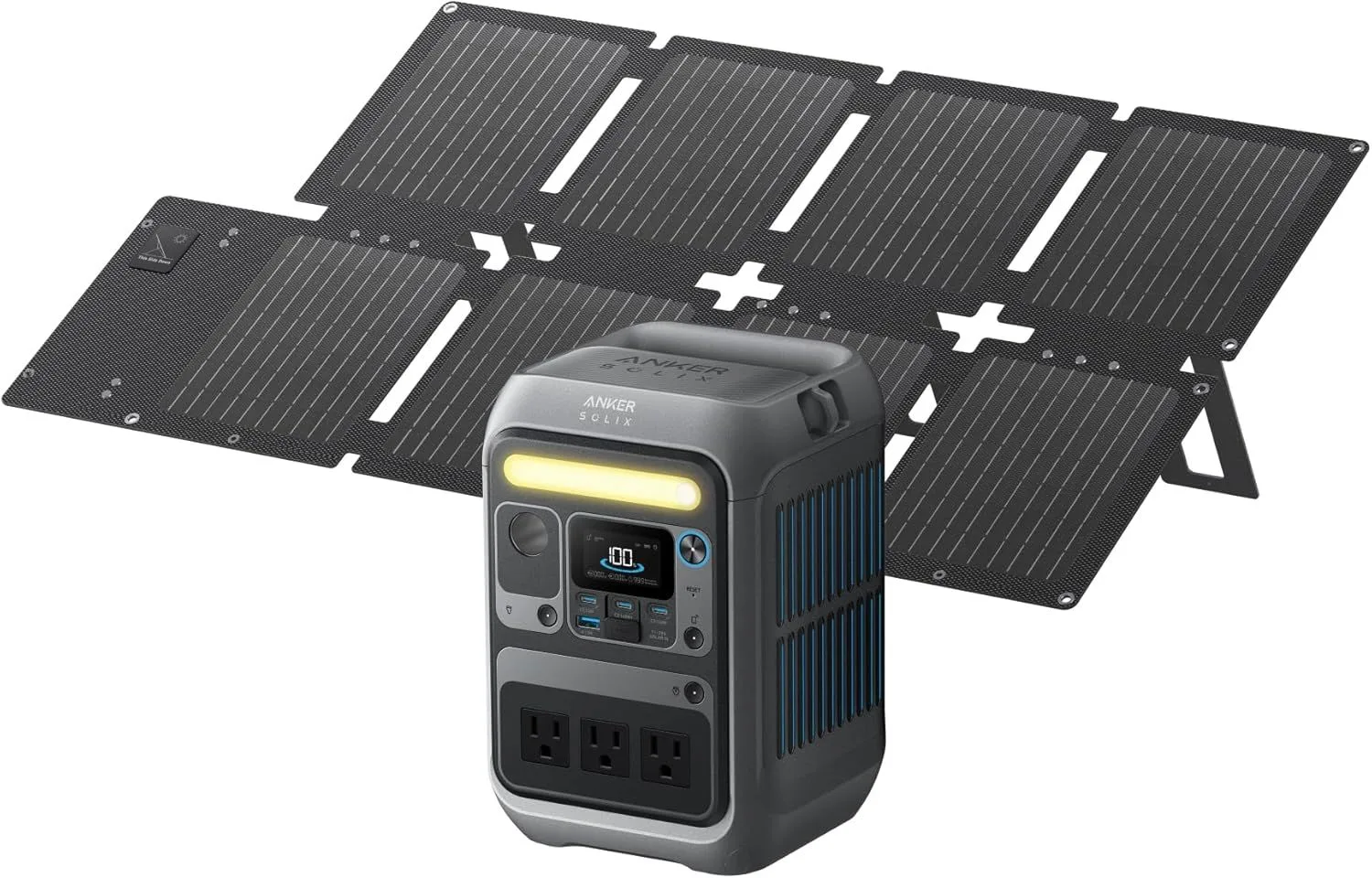
Anker SOLIX C300
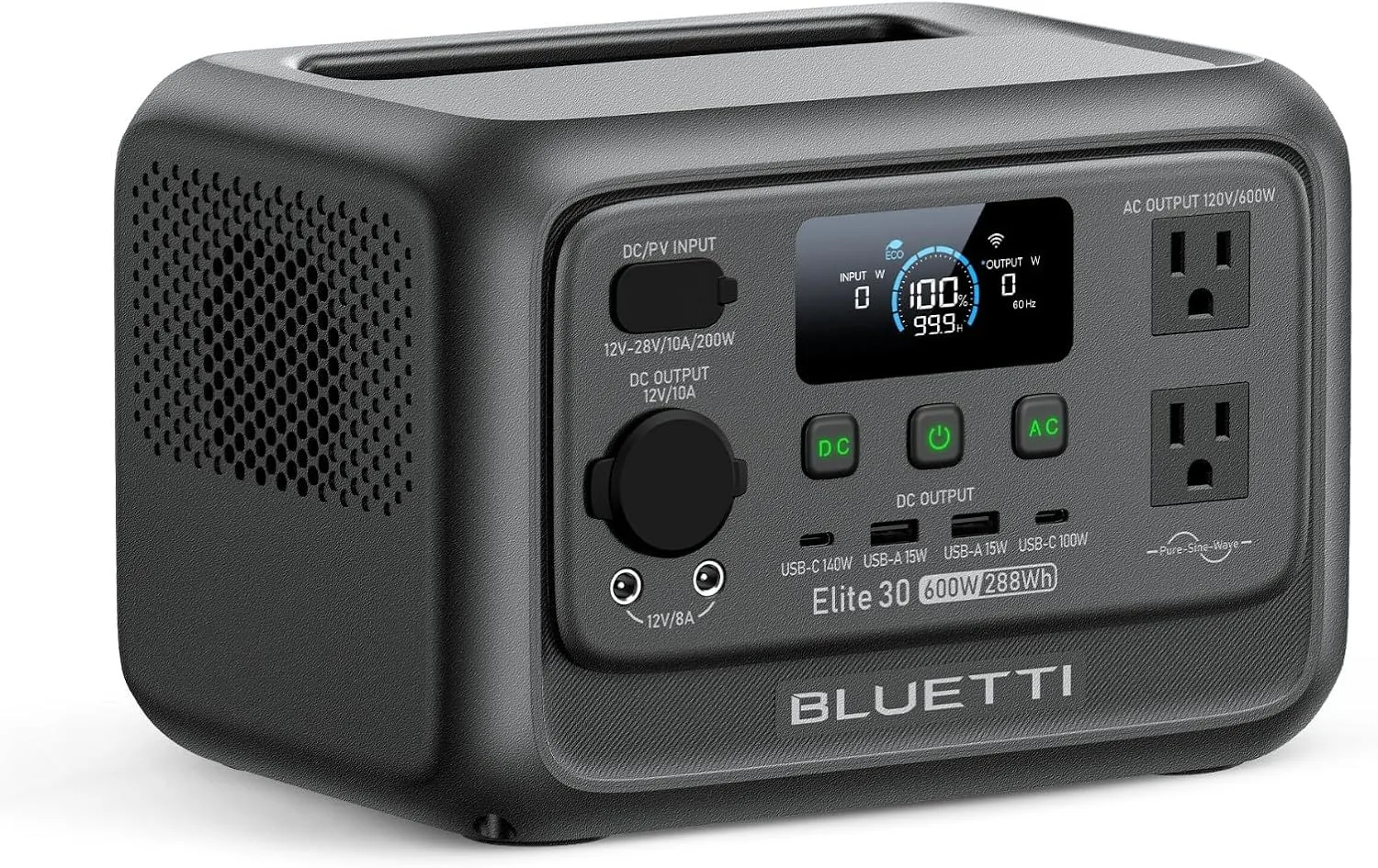
BLUETTI Elite 30 V2
Head-to-Head Specifications
These two stations sit at the top of the compact portable generator category. Both use LiFePO4 chemistry, both carry 5-year warranties, and both feature premium USB-C ports. The differences are in output power, noise levels, included accessories, and smart features. Here is the full specification comparison.
| Feature | Anker SOLIX C300 Portable Power Station with 60W Solar Panel | BLUETTI Elite 30 V2 Portable Power Station |
|---|---|---|
| Price Range | $100–$250 | $100–$250 |
| Battery Capacity | 288Wh | 288Wh |
| Battery Type | LiFePO4 | LiFePO4 |
| Output Power | 300W | 600W |
| Surge Power | 600W (SurgePad) | 1,500W (Power Lifting) |
| Weight | ~9 lbs | 9.48 lbs |
| Solar Input | 100W max (XT60, 11-28V, MPPT) | 200W max (12-28V, MPPT) |
| Check Price | Check Price |
Where Each Station Excels
Raw Output Wattage
BLUETTI Elite 30 V2 WinsThe BLUETTI Elite 30 V2 delivers 600W continuous output from its AC outlets — exactly double the Anker SOLIX C300's 300W. From the same 288Wh battery, the BLUETTI can power a wider range of devices including small appliances, portable heaters on low settings, and power tools that the Anker simply cannot run.
BLUETTI's Power Lifting mode pushes the effective output ceiling even higher. For resistive loads (devices that convert electricity directly to heat, like space heaters, hair dryers, and electric kettles), Power Lifting can handle up to 1,500W by intelligently managing voltage delivery. This means a 1,000W electric kettle that would trip the Anker's overload protection runs successfully on the BLUETTI.
The Anker does feature SurgePad technology that handles brief surge loads up to 600W — matching the BLUETTI's continuous rating. But SurgePad is designed for motor startup spikes lasting milliseconds, not sustained operation. For anything beyond phone and laptop charging, the BLUETTI's output advantage is decisive.
In practical terms, the output gap means the BLUETTI handles a wider universe of road trip and camping gear. A portable blender (300-500W), a small electric griddle (400-600W), or a CPAP humidifier with heated tubing (150-300W) all run comfortably within the BLUETTI's 600W envelope. The Anker caps out at items like phone chargers, laptops, LED lights, and small fans. If your packing list includes anything with a heating element or a motor, the BLUETTI is the safer pick.
Noise and Quiet Operation
Anker SOLIX C300 WinsThe Anker SOLIX C300 operates at 25dB — independently verified by Battery Essence as whisper-quiet. For context, 25dB is quieter than a rural nighttime environment. You can place this station next to your bed running a CPAP machine and not hear it.
The BLUETTI Elite 30 V2 does not publish an official noise specification, which is often an indicator that the number is not a selling point. Multiple BLUETTI community forum users and reviewers have noted audible fan cycling during charging and under moderate-to-high output loads. The fan is not loud — it is not going to wake you from across the room — but it is present and noticeable in quiet environments.
For tent camping, bedside CPAP use, quiet home offices, and any scenario where audible fan noise is a dealbreaker, the Anker SOLIX C300 is the only real option between these two. This single feature justifies the Anker's existence in a category where the BLUETTI otherwise dominates on specifications.
The noise difference is most obvious during charging. The Anker stays quiet throughout its 70-minute AC charge cycle. The BLUETTI's turbo charging mode pushes the battery hard, and the thermal management system ramps fans to compensate. If you charge the BLUETTI at night in a hotel room or a shared cabin, you will hear it. The standard (non-turbo) charging mode is quieter but takes roughly twice as long to reach full.
AC Recharging Speed
Anker SOLIX C300 WinsThe Anker SOLIX C300 hits 80% charge in 50 minutes and reaches full in approximately 70 minutes. CNN Underscored and Bob Vila both verified these numbers independently. For road trippers who stop for lunch, the Anker goes from dead to nearly full in the time it takes to eat.
The BLUETTI Elite 30 V2 is fast, but a step behind — reaching 80% in 45 minutes via its Turbo mode and full charge in approximately 2 hours. The 80% times are close (Anker: 50 min, BLUETTI: 45 min), but the BLUETTI takes noticeably longer to go from 80% to 100% as the charging taper kicks in.
Both stations charge far faster than the rest of the compact class — the Jackery Explorer 300 takes 4 hours from a wall outlet. But in a direct comparison, the Anker's total charge time from empty to full is shorter.
Solar Capability and Included Accessories
Anker SOLIX C300 WinsThe Anker SOLIX C300 includes a 60W solar panel in the box. The BLUETTI Elite 30 V2 does not include any solar panel — purchasing a compatible BLUETTI panel adds substantially to the total investment.
For buyers who want solar charging out of the box, the Anker eliminates the guesswork. The included 60W panel is matched to the station's input specs, and Anker's 5-year warranty covers both the station and the panel. No compatibility research needed.
The BLUETTI does accept higher-wattage solar input — up to 200W versus the Anker's 100W maximum. With a 200W panel, the BLUETTI recharges from solar in approximately 2.2 hours compared to the Anker's 4-5 hours with its 60W panel. But that 200W panel is a separate purchase. If you already own compatible solar panels or plan to invest in a larger setup, the BLUETTI's higher solar ceiling is an advantage. If you want a ready-to-go solar kit, the Anker wins.
One detail worth considering: the Anker's included 60W panel is a folding design with an integrated kickstand. It weighs about 4.4 lbs and packs flat alongside the station for travel. The total Anker kit — station plus panel — fits in a single carry bag. The BLUETTI station alone is lighter to transport, but once you add a separately purchased solar panel, total kit weight and bulk can exceed the Anker bundle. For car camping where trunk space is limited, the Anker's all-in-one packaging is the tidier solution.
Smart Features and UPS Capability
BLUETTI Elite 30 V2 WinsThe BLUETTI Elite 30 V2 includes Wi-Fi and Bluetooth app control with real-time monitoring, port toggling, and firmware updates. The Anker SOLIX C300 also features an Anker app with Bluetooth connectivity. Both apps are functional — the BLUETTI app offers slightly more granular control over charging modes and output settings.
Where the BLUETTI pulls ahead decisively is UPS functionality. The 10ms switchover time is fast enough to keep desktop computers, NAS devices, networking equipment, and other sensitive electronics running without interruption during a power outage. Multiple reviewers verified uninterrupted power maintenance during simulated grid failures.
The Anker SOLIX C300 does not offer UPS functionality. If uninterruptible backup power is a requirement — for a home office, server, or medical equipment — the BLUETTI is the only choice between these two stations.
The BLUETTI's UPS mode is particularly useful for home office setups. Plug your monitor, router, and laptop charger into the BLUETTI, keep it connected to wall power via pass-through charging, and it acts as a silent, always-ready backup. When grid power drops, the 10ms switchover is fast enough that your Zoom call stays connected and your files stay saved. At 288Wh, you get roughly 2-3 hours of runtime for a typical home office load (monitor + router + laptop), which is long enough to save work and shut down gracefully — or ride out most brief outages entirely.
Port Selection
Anker SOLIX C300 WinsThe Anker SOLIX C300 provides 3 AC outlets, 2x 140W USB-C, 1x 15W USB-C, 1x USB-A, and a car socket — 8 ports total. The BLUETTI Elite 30 V2 offers 2 AC outlets, 1x 140W USB-C, 1x 100W USB-C, 2x USB-A, 2x DC5521, and a car port — 9 ports total.
The Anker wins on AC outlet count (3 vs 2) — useful when you need to plug in multiple devices without a power strip. The BLUETTI wins on total port count and DC output variety with its twin DC5521 ports for direct-connect accessories.
Both stations share the standout feature of 140W bidirectional USB-C — capable of fast-charging the latest MacBook Pro at maximum speed. The Anker goes further with a second lower-wattage USB-C port (15W) that handles phones and earbuds without occupying the high-power port. For most users, the port layouts are close enough that neither station has a decisive edge.
One port detail that trips up first-time buyers: the car socket (12V DC output) on both stations is not the same as a car cigarette lighter in terms of amperage. The Anker's car socket handles most 12V accessories — tire inflators, coolers, ham radios — but high-draw 12V devices may exceed its rated output. The BLUETTI's car port performs similarly. If you plan to power 12V accessories beyond basic electronics, check the device's draw against the station's DC output spec before relying on it during a road trip or campsite setup.
Weight, Size, and Travel Practicality
TieThe Anker SOLIX C300 weighs 10.2 lbs for the station alone, plus the bundled 60W panel adds roughly 4.4 lbs — bringing the total ready-to-go kit to about 14.6 lbs. The BLUETTI Elite 30 V2 weighs 10.6 lbs without any panel. Both fit inside a carry-on suitcase if you remove the solar panel, and both pass TSA guidelines for lithium batteries under 300Wh (both sit at 288Wh, well under the FAA's 300Wh carry-on threshold as of early 2026).
For van lifers and overlanders, footprint matters as much as weight. Both stations measure roughly 12 inches wide and 8 inches deep. They slide into a milk crate, under a bench seat, or behind a passenger seat without rearranging your gear. The Anker's bundled panel folds flat to about 21 x 16 inches — thin enough to slip between a seat back and a storage bin.
Airline travel introduces an additional wrinkle. Both stations fall under the 300Wh limit, but individual airlines enforce their own rules on lithium battery size, labeling, and carry-on placement. Delta, United, and Southwest all allow batteries under 300Wh in carry-on luggage (never checked), but some international carriers cap allowed batteries at 160Wh. If you fly internationally with either station, verify your airline's specific policy before arriving at the gate. Domestic US flights with either unit have been confirmed by multiple travel reviewers with no issues — both stations have clear Wh labels printed on the casing, which TSA agents check at security.
For backpacking or hiking where every ounce counts, neither station is the right tool. At 10+ lbs, these are car-camping and van-living products. If you need trail-portable power, look at sub-5-lb options in a different class entirely. But for any use case that involves a vehicle — car camping, tailgating, RV trips, photography on location, construction site charging — both the Anker and BLUETTI are compact and light enough to toss in a bag and go.
Temperature tolerance is another travel consideration. Both stations use LiFePO4 cells rated for charging between 32°F and 113°F. Below freezing, neither station accepts charge input — a critical limitation for winter camping. You can discharge both units down to about 14°F, but recharging requires warming the station above freezing first. If you plan to use either station in cold-weather camping scenarios, store it inside your vehicle or sleeping area overnight to keep the cells above their charging threshold. The Anker's included solar panel also loses efficiency in extreme cold — expect 15-20% less output below 40°F compared to the panel's rated spec at 77°F.
The Right Station for Your Needs
Get the Anker SOLIX C300 if...
- → Quiet operation is non-negotiable — bedside CPAP, shared tent, quiet hotel room
- → You want a solar panel included and ready to use without compatibility research
- → You primarily charge phones, laptops, and cameras — 300W is enough for gadgets
- → You value Anker's customer support reputation and want 3 AC outlets instead of 2
Get the BLUETTI Elite 30 V2 if...
- → You need to power small appliances — the 600W output handles loads the Anker cannot
- → You want UPS backup for a desktop, NAS, or home networking equipment
- → You already own solar panels or plan to buy a high-wattage panel (up to 200W input)
- → You want more output per dollar — the BLUETTI delivers 600W for modestly more expensive compared to the Anker's 300W
- → Power Lifting mode for occasional high-wattage appliances is appealing
If you are buying a power station specifically for CPAP therapy, the Anker SOLIX C300's 25dB noise floor is the deciding factor. A CPAP machine itself operates at 26-30dB — the power station should not be louder than the device it powers. Bob Vila confirmed the Anker ran a laptop and phone for a full week on one charge with 32% remaining, and Battery Essence verified the whisper-quiet operation claim. For CPAP users, the Anker is the only real choice in the compact class.
Anker SOLIX C300 vs BLUETTI Elite 30 V2 FAQ
Which has better output — the Anker SOLIX C300 or BLUETTI Elite 30 V2?
The BLUETTI Elite 30 V2 delivers 600W continuous output — double the Anker SOLIX C300 at 300W. The BLUETTI also features Power Lifting mode that handles resistive loads up to 1,500W. If you need to power small appliances beyond phones and laptops, the BLUETTI wins decisively.
Is the Anker SOLIX C300 quieter than the BLUETTI Elite 30 V2?
Yes, the Anker SOLIX C300 operates at 25dB — confirmed by Battery Essence as whisper-quiet. The BLUETTI Elite 30 V2 does not publish a specific noise figure, and multiple users have noted audible fan activity during charging and high-output use. For bedside CPAP use or tent camping where silence matters, the Anker is the clear choice.
Does the Anker C300 solar panel work with the BLUETTI Elite 30 V2?
No. The Anker SOLIX C300 bundles a 60W panel with a proprietary XT60 connector designed for Anker stations. The BLUETTI Elite 30 V2 accepts solar input via its own connector type up to 200W max. The panels are not cross-compatible between brands. Each station requires its own brand-specific or adapter-compatible solar panel.
Which compact power station has better USB-C charging?
Both stations feature 140W bidirectional USB-C ports — the highest in the compact class. This means both can fast-charge the latest MacBook Pro at maximum speed and accept USB-C input charging. It is essentially a tie on USB-C capability, though the BLUETTI adds a second 100W USB-C port for simultaneous dual-device fast charging.
Can either station work as a UPS for a desktop computer?
The BLUETTI Elite 30 V2 includes a 10ms UPS switchover mode — fast enough to keep most desktop computers and networking equipment running during a power interruption. The Anker SOLIX C300 does not advertise UPS functionality. For desktop UPS use, the BLUETTI is the only viable option between these two.
How long will each station power a laptop during a flight delay or layover?
A modern laptop draws 30-60W depending on workload. At 45W average, both 288Wh stations deliver roughly 5.5-6 hours of runtime after inverter losses. The Anker's 140W USB-C port bypasses the AC inverter entirely — plugging your laptop into USB-C instead of the AC outlet extends runtime by about 15% because there is no DC-to-AC conversion loss. The BLUETTI offers the same USB-C advantage. For pure laptop use, both stations perform almost identically.
Which station handles cold weather better?
LiFePO4 batteries in both stations lose capacity below 32°F (0°C) — expect 15-20% less usable energy at freezing. Neither station includes built-in battery heating. The Anker's lower power draw at idle means it preserves slightly more capacity in cold conditions, but the difference is marginal. For winter camping, keep either station inside a sleeping bag or insulated cooler bag overnight to maintain battery temperature above freezing.
Can I charge one station from the other in an emergency?
Yes — both stations have 140W bidirectional USB-C ports. Connect a USB-C cable between them and the station with more charge will feed the one with less. Transfer efficiency is roughly 85-90% (you lose 10-15% to conversion). It is not fast, but it works in a pinch if one station is dead and the other still has charge. This is a useful trick for couples who each carry a different station.
The Value Equation: What You Get Per Dollar
The BLUETTI Elite 30 V2 delivers more raw capability per dollar by almost every measure. Double the output wattage, UPS mode, Power Lifting to 1,500W, and faster turbo charging — all at a lower list price than the Anker C300 with its bundled panel. If you strip out the solar panel from the Anker's price, the station-only cost is closer to the BLUETTI, but you also lose the key differentiator that makes the Anker bundle attractive.
The Anker's value proposition depends entirely on whether you need a solar panel and whisper-quiet operation. If those two features matter to you, the Anker bundles them at a combined price that is competitive with buying a BLUETTI plus a separate 60W panel. If those features do not matter, the BLUETTI is the better buy — you get a more capable station for less money and can invest the savings into accessories you actually need.
Long-term cost is similar for both. LiFePO4 chemistry in both units delivers 3,000+ cycles to 80% capacity — at one cycle per day, that is over 8 years of daily use before the battery degrades meaningfully. Our solar generator buying guide breaks down how to evaluate capacity and features for your specific needs. Both carry 5-year manufacturer warranties. Neither station has recurring costs beyond the electricity used to charge them.
Check Current Pricing
Anker SOLIX C300
$100–$250 · 288Wh · Includes 60W Panel
Best for: whisper-quiet CPAP use and solar-ready kits
Check PriceBLUETTI Elite 30 V2
$100–$250 · 288Wh · 600W Output
Best for: maximum output, UPS backup, and appliance power
Check PricePrices and availability change frequently. Both links go to Amazon where you can verify current pricing. As an Amazon Associate, Solar Power Guides earns from qualifying purchases — this does not affect our analysis or recommendations.