Anker C2000 Gen 2 vs FOSSiBOT F2400 (2026)
Bottom Line
The FOSSiBOT F2400 matches Anker's battery size and beats it on raw output — for roughly half the price. But the Anker C2000 Gen 2 is lighter, charges faster, offers expandability, and comes with a 5-year warranty from a brand that won't vanish. Your budget decides this one: the FOSSiBOT if you want maximum watts per dollar today, the Anker if you want a system that grows and lasts.
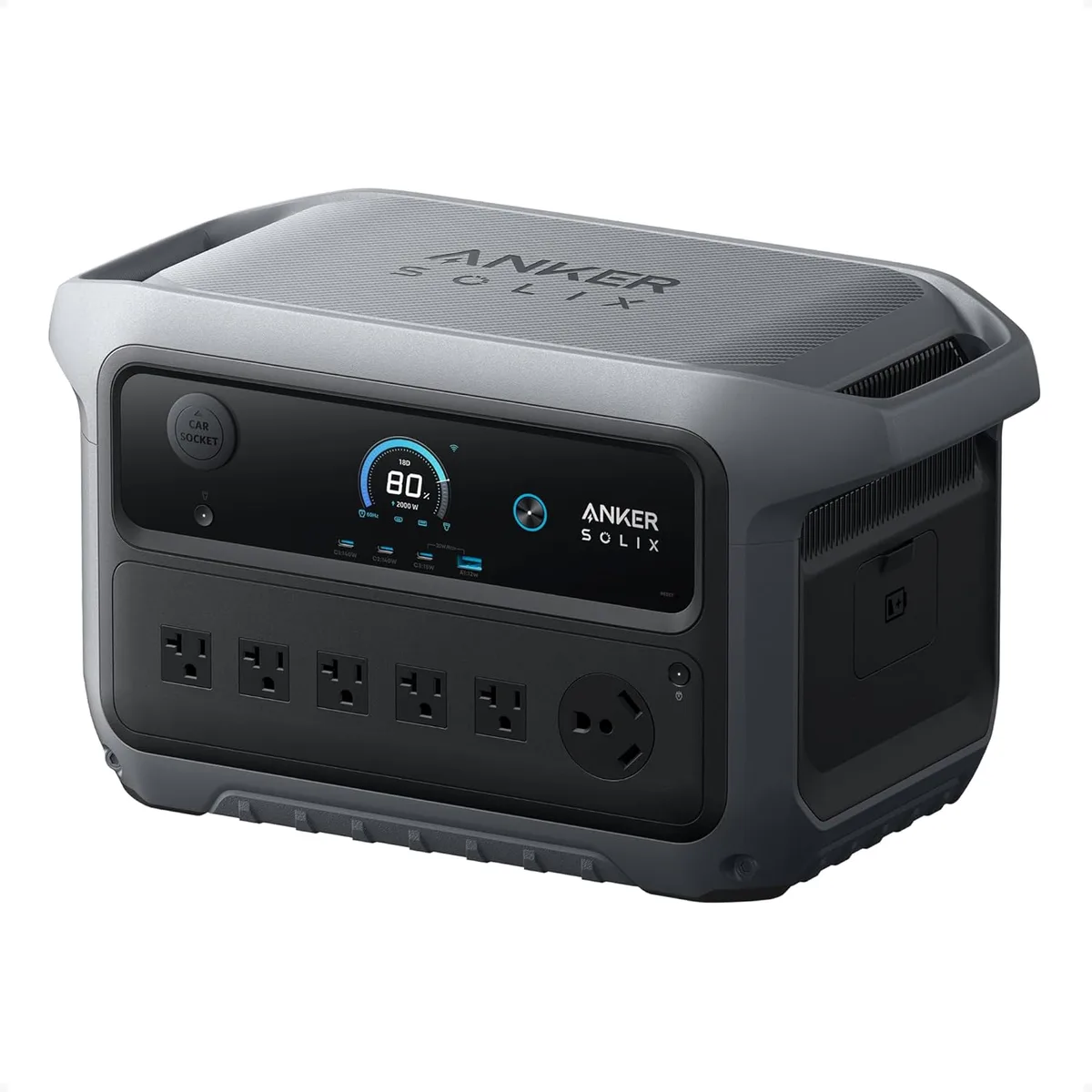
Anker SOLIX C2000 Gen 2
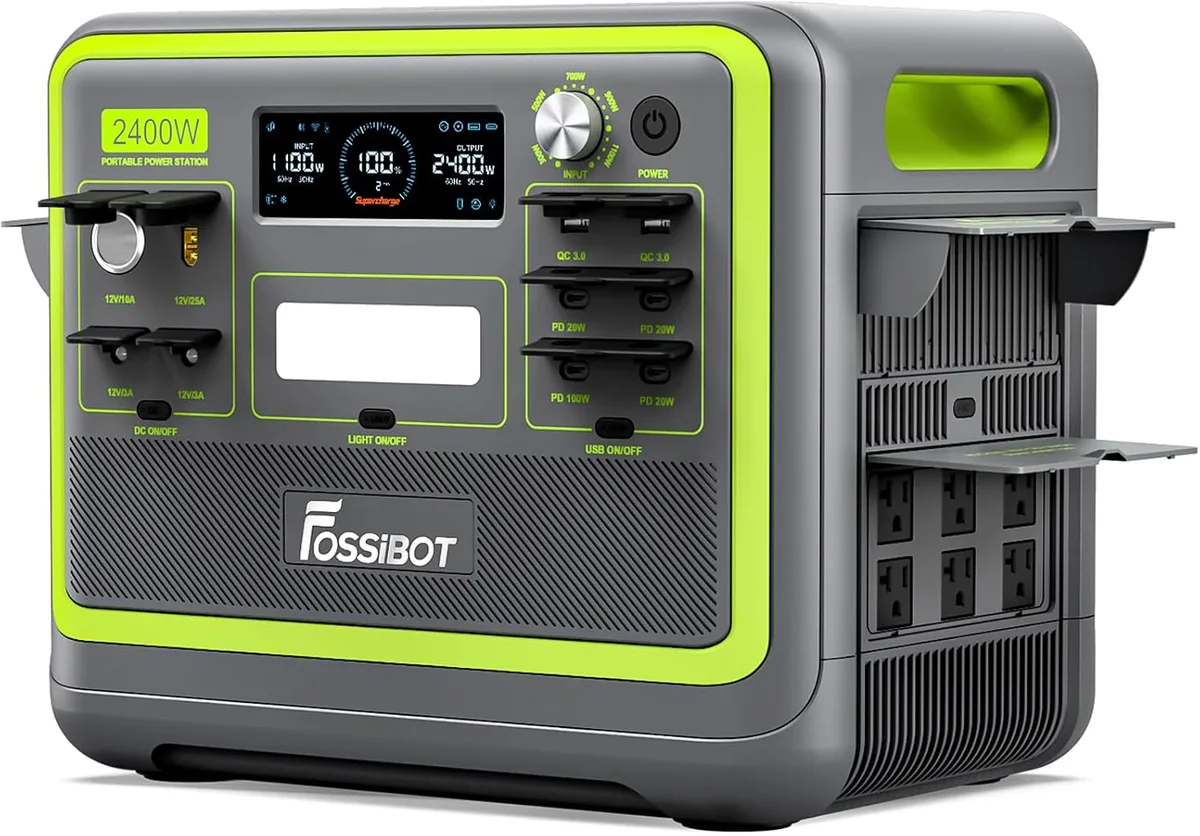
FOSSiBOT F2400
Two 2,048Wh Stations, One Big Price Gap
On paper, these units look like twins — identical 2,048Wh LiFePO4 batteries, 2,400W continuous output, and 4,000+ cycle lifespans. Then you check the receipt. The Anker SOLIX C2000 Gen 2 runs top-tier investment while the FOSSiBOT F2400 sits at top-tier investment — making it significantly more expensive.
That price gap buys real differences: 7 fewer pounds on the Anker, an expansion path to 4,096Wh, a 5-year warranty versus 4, and the most polished display and app in portable power. The FOSSiBOT counters with 5 more output ports, higher surge wattage, and an adjustable AC input dial that no competitor at any price offers. Neither unit is objectively "better" — they target different buying philosophies. Our high-capacity roundup ranks both alongside their closest competitors.
The battery chemistry is identical — both use LiFePO4 cells rated for 4,000+ cycles to 80% capacity. At one full cycle per day, that translates to roughly 11 years before degradation hits the 80% mark. Most home backup users cycle their station a handful of times per month, which means either unit should outlast its warranty by a wide margin. The real question is not how long these batteries last — it is whether you pay a premium for the engineering and ecosystem wrapped around those cells, or pocket the savings and accept a more bare-bones package.
| Feature | Anker SOLIX C2000 Gen 2 Portable Power Station | FOSSiBOT F2400 Portable Power Station |
|---|---|---|
| Price Range | $500+ | $500+ |
| Battery Capacity | — | 2,048Wh |
| Battery Type | — | LiFePO4 (EVE cells) |
| Output Power | 2,400W continuous | 2,400W continuous |
| Surge Power | 4,000W peak | 4,800W peak |
| Weight | 41.7 lbs (18.9 kg) | 48.5 lbs |
| Solar Input | 800W max | 500W max |
| Check Price | Check Price |
Anker Wins Weight and Portability
The Anker C2000 Gen 2 weighs 41.7 lbs — nearly 7 lbs lighter than the FOSSiBOT's 48.5 lbs. That gap sounds modest on paper. In practice, 41 lbs is the threshold where most adults can still carry a power station one-handed from the car to a campsite. At 48.5 lbs, you need two hands every time.
Anker shed 25 lbs from the F2000 predecessor to reach this weight class — impressive engineering for a 2kWh LiFePO4 unit. The FOSSiBOT's extra weight comes partly from its larger chassis (15.2 x 11.2 x 12.6 in versus 18.1 x 9.8 x 10.1 in) — wider and taller, though narrower front-to-back. If you load your station into a van or truck bed every weekend, the 7-lb difference adds up over months of lifting.
The size difference also affects storage. The Anker's narrower, longer footprint fits into tighter spaces — RV storage compartments, closet shelves, and truck bed toolboxes that would not accommodate the FOSSiBOT's wider body. For mobile users who need to pack efficiently around other gear, the Anker's form factor is the more practical shape.
Consider the daily routine for someone using a power station in an RV or work van. You unload it at the campsite, set it up on a table, plug in devices, then reverse the process at the end of the trip. That is four lifts per trip. Over a camping season of 20 weekends, the Anker saves you 80 lifts at 7 lbs less per lift — 560 fewer pounds of cumulative effort. It sounds trivial in isolation, but anyone with a back injury or shoulder strain will tell you 41 lbs and 48 lbs are different categories of effort when lifting from ground level to a truck bed height of 30+ inches.
FOSSiBOT Wins Output Power and Surge Handling
Both stations deliver 2,400W continuous, but the FOSSiBOT's 4,800W peak surge gives it 20% more headroom than Anker's 4,000W surge. That extra 800 watts of peak capacity matters for motor-start appliances — compressor fridges, power tools, and well pumps all draw 2-3x their rated wattage for a fraction of a second during startup.
A table saw with a 15A motor draws around 3,000-3,500W on startup. The FOSSiBOT handles it without flinching. The Anker might as well — 4,000W is still generous — but the margin is tighter. For buyers running heavy tools or multiple appliances simultaneously, that 4,800W ceiling provides real peace of mind.
Run the appliance math on a typical outage scenario. A full-size fridge cycles at about 150W average, a Wi-Fi router pulls 12W, a few LED lights add 30W, and you want to charge two phones (10W each). That baseline is roughly 212W — well within both units' comfort zone. But then the fridge compressor kicks in, the microwave fires up at 1,200W for reheating dinner, and someone plugs in a 1,500W space heater. Suddenly you need 2,900W continuous plus a compressor inrush spike. The FOSSiBOT handles the full load. The Anker needs you to stagger the microwave and heater — a minor inconvenience, but a real one during a winter outage when you want hot food and warm air at the same time.
Anker Wins Charging Speed
Anker charges from empty to full in roughly 90 minutes on AC power alone. Combine AC with an 800W solar array and it drops to 58 minutes — under an hour for a 2,048Wh battery. The FOSSiBOT needs about 2 hours on AC at full 1,100W input, or 1.5 hours with combined AC and solar.
That 30-minute gap matters more than it sounds. During a rolling blackout with two-hour power windows, the Anker hits a full charge before the grid drops again. The FOSSiBOT finishes at roughly the same moment the power cuts — leaving you at 90-95% instead of 100%. Over multiple cycles during an extended grid event, that 5-10% compounding shortfall could mean the difference between keeping the fridge running through the night or waking up to warm food.
The FOSSiBOT's adjustable AC input dial is a clever touch, though. That physical silver knob lets you set charging wattage anywhere from 300W to 1,100W — useful if you're plugged into a shared circuit at a campground and don't want to trip the breaker. Anker manages this through its app instead of hardware. Both approaches work; the FOSSiBOT's is more intuitive for non-tech users.
Solar charging tells a different story. The Anker accepts up to 1,000W of solar input versus the FOSSiBOT's 500W maximum. That 2x gap is substantial. On a clear summer day, a 400W panel array feeds both units comfortably — but push to 600W or 800W of panels and the Anker keeps climbing while the FOSSiBOT hits its ceiling. For off-grid setups where solar is the primary charging source, the Anker refills in half the time with the same panel array.
The solar input gap also affects panel investment strategy. Someone who starts with a pair of 200W solar panels (400W total) will eventually want to add more. With the Anker, upgrading to four 200W panels (800W total) cuts recharge time from roughly 5 hours to about 2.5 hours. With the FOSSiBOT, those extra panels sit idle because the charge controller caps at 500W. You have paid for 800W of solar hardware but only 500W reaches the battery. Over the lifespan of the system, the Anker extracts more value from every panel dollar spent.
FOSSiBOT Wins Port Count and Variety
The FOSSiBOT packs 16 output ports versus Anker's 11. That's not just a spec-sheet flex — 6 AC outlets (vs 5), 4 USB-C ports (vs 3), and a dedicated 12V/25A RV outlet that the Anker only matches with a TT-30 plug not rated for full 30A continuous draw.
For van life or car camping with multiple people, the FOSSiBOT's port abundance means fewer "can I plug in?" negotiations. Two phones, a laptop, a cooler, LED lights, and a drone charger all running simultaneously without a power strip. The Anker handles 11 devices at once — still plenty for most scenarios, but the FOSSiBOT simply has more runway.
Look at the port layout more closely and the differences become practical. The FOSSiBOT groups all six AC outlets on one side of the unit — convenient for running a power strip or plugging in multiple kitchen appliances without cable management headaches. The Anker distributes its five AC outlets across a wider panel alongside USB ports, which looks cleaner but means AC cables and USB cables compete for the same space. The FOSSiBOT also includes two DC5521 barrel connectors (12V/10A each) for legacy devices like LED strip controllers and older car-charger adapters — ports the Anker skips entirely.
Anker Wins Expandability and Long-Term Investment
The Anker C2000 Gen 2 accepts a BP2000 Gen 2 expansion battery, doubling total capacity to 4,096Wh. The FOSSiBOT F2400 is a closed system — 2,048Wh, forever. This single difference changes the buying equation depending on your timeline.
If you know 2,048Wh is enough — running a fridge, lights, and phones during a typical 8-12 hour outage — the FOSSiBOT delivers that for far less money. But if you are building a home backup system that might need to grow as your power needs increase, the Anker's expansion path means you do not start over. Adding a BP2000 Gen 2 later is cheaper than buying a second standalone unit.
The expansion math favors Anker for anyone who expects their power needs to increase. A growing family adds devices. A home office adds monitors and networking gear. An RV owner adds a larger fridge or a second AC zone. With the Anker, you buy the expansion battery when you need it — no new inverter, no new display, no rewiring. The FOSSiBOT buyer in the same situation faces a harder choice: buy a second standalone unit (doubling cost and floor space) or sell and start over with a larger system.
Put it in runtime terms. A base 2,048Wh system running a 150W average fridge load delivers roughly 12-13 hours of continuous power (accounting for inverter losses). With the BP2000 Gen 2 expansion, the Anker doubles that to 24-26 hours — enough to ride out a full day without grid power or solar input. The FOSSiBOT stays fixed at 12-13 hours regardless of what you buy later. For buyers in hurricane-prone or wildfire-risk regions where 24+ hour outages are common, the Anker's expansion path is not a convenience — it is insurance against a second night without power. Our emergency preparedness guide covers how to size a system for extended outages.
Brand, Warranty, and the Trust Factor
Anker has sold millions of charging products worldwide. Their customer support is US-based, their warranty is 5 years, and replacement parts are readily available. The Storm Guard feature — auto-charging when severe weather alerts hit your area — shows the kind of software investment that comes from a large engineering team.
FOSSiBOT is newer and less established in North America. Their 4-year warranty (with registration) is respectable, but the long-term service infrastructure is unproven. Several early adopters reported quality variance — that 1,200Wh real-world capacity measurement from one reviewer is concerning, though FOSSiBOT offered an immediate replacement. If the brand matures well, early buyers will have gotten outstanding value. If support infrastructure doesn't scale, that warranty may be harder to exercise.
The display quality gap is worth calling out separately. The C2000 Gen 2's screen is bright, crisp, and readable in direct sunlight with real-time wattage, battery percentage, remaining runtime estimates, and input/output flow visualization. The FOSSiBOT's display works but lacks the contrast, brightness, and data density of Anker's panel. When you are running multiple devices and need to know exactly how much draw each circuit is pulling before plugging in one more appliance, the Anker's display gives you the information at a glance. The FOSSiBOT requires more guesswork.
Battery Longevity: 4,000 Cycles in Real Terms
Both units use LiFePO4 cells rated for 4,000+ cycles to 80% original capacity. That number sounds abstract until you map it to actual use. If you drain the battery 50% every day — running a fridge, lights, and a few devices overnight — that is one half-cycle per day, or roughly one full cycle every two days. At that rate, 4,000 cycles translates to over 20 years of daily use before the battery degrades to 80%. Even aggressive daily full-drain usage yields a decade of service.
The difference is what happens after those cycles. Anker's established supply chain means replacement batteries and service parts will likely remain available for the unit's entire lifespan. FOSSiBOT's newer market presence makes long-term parts availability less predictable. A power station that lasts 15 years mechanically is only useful for 15 years if you can still get a replacement BMS board or charging cable when something wears out.
Who Should Get Which?
Get the Anker C2000 Gen 2 if you:
- Use it as always-on home backup. The 9W idle draw means the Anker loses less than 1% of its charge per day sitting in standby. Storm Guard auto-charges when severe weather approaches your area. For a unit that lives plugged in and waits for outages, no other 2kWh station wastes less energy doing nothing.
- Want to add capacity later. The BP2000 Gen 2 expansion battery doubles your system to 4,096Wh without buying a second inverter or display. If your power needs might grow in the next 2-3 years, the expansion path saves money long-term.
- Carry your station frequently. At 41.7 lbs, the C2000 Gen 2 is one of the lightest 2kWh LiFePO4 units available. The 7-lb gap over the FOSSiBOT compounds every time you lift it into a vehicle, carry it across a campsite, or move it between rooms.
- Care about display and app quality. The C2000 Gen 2 has what reviewers consistently call the best display in portable power — crisp, bright, and readable in direct sunlight. The app provides reliable WiFi/Bluetooth monitoring with real-time power flow visualization.
Get the FOSSiBOT F2400 if you:
- Want maximum value now. The FOSSiBOT delivers identical battery capacity and matching continuous output at a price that is roughly half the Anker's. If your budget is fixed and you need 2kWh of LiFePO4 power today, no other option matches this cost-per-watt-hour ratio.
- Run many devices simultaneously. Sixteen output ports — including 6 AC outlets, 4 USB-C, and a dedicated 12V/25A RV outlet — mean you can power an entire campsite or tailgate setup without a power strip. The Anker's 11 ports are adequate; the FOSSiBOT's 16 are generous.
- Need higher surge capacity. The FOSSiBOT's 4,800W peak surge gives 800W more headroom than the Anker's 4,000W. For motor-start appliances like compressor fridges, table saws, and RV air conditioners, that extra surge margin reduces tripped breakers.
- Charge from shared circuits. The physical AC input dial (300W-1,100W) lets you throttle charging current without an app. At a campground with a shared 15A circuit, dial it down to 500W and avoid tripping the breaker for your neighbors.
Anker SOLIX C2000 Gen 2 vs FOSSiBOT F2400 FAQ
Why does the Anker C2000 Gen 2 cost almost double the FOSSiBOT F2400?
You are paying for refinement, not raw capacity. Anker delivers a lighter chassis (41.7 lbs vs 48.5 lbs), ultra-low 9W idle draw, a display reviewers call the best in the industry, Storm Guard weather alerts, expandability to 4,096Wh, and a 5-year warranty. FOSSiBOT matches Anker on battery size and beats it on output wattage and port count — but with heavier construction, shorter warranty, and no expansion path.
Can the FOSSiBOT F2400 run a space heater?
Yes. Its 2,400W continuous / 4,800W surge inverter handles most 1,500W space heaters without breaking a sweat. The Anker C2000 Gen 2 also runs a 1,500W heater, but its 4,000W surge provides less headroom than the FOSSiBOT's 4,800W peak for inrush-heavy loads.
Which charges faster from a wall outlet?
The Anker C2000 Gen 2 wins on AC charging — roughly 90 minutes to full versus about 2 hours for the FOSSiBOT F2400. Combine AC with solar and Anker hits full charge in just 58 minutes. The gap narrows but never closes.
Can I add extra batteries to either unit?
Only the Anker. The C2000 Gen 2 accepts a BP2000 Gen 2 expansion battery, doubling total capacity to 4,096Wh. The FOSSiBOT F2400 is fixed at 2,048Wh with no expansion option — what you buy is what you get.
Which is better for full-time van life?
The FOSSiBOT F2400 edges ahead for van dwellers on a budget — it has a dedicated 12V/25A RV outlet, 16 total ports for simultaneous device charging, and costs less. But if you plan to add solar capacity over time or want a lighter unit you carry in and out of the van daily, the Anker's expandability and 7-lb weight advantage matter.
How do the warranties compare?
Anker offers a 5-year full-device warranty with established US-based customer support. FOSSiBOT provides 2 years standard, extendable to 4 years with product registration. Given that FOSSiBOT is a newer brand with less North American service history, the warranty gap matters more than the numbers suggest.
How loud are these units during operation?
The Anker C2000 Gen 2 is among the quieter 2kWh stations — fan noise stays low under moderate loads and the unit operates near-silently below 500W. The FOSSiBOT F2400 runs louder, particularly under sustained high draw. Multiple Amazon reviewers noted audible fan noise during loads above 1,000W. Neither is as quiet as the EcoFlow DELTA 3 MAX (sub-25dB), but the Anker is noticeably less intrusive in a bedroom or living room setting.
What is the idle power draw on each station?
The Anker C2000 Gen 2 draws just 9W at idle — the lowest in the 2kWh class. That means the battery drains less than 1% per day when sitting powered on with no load. The FOSSiBOT F2400 has a higher idle draw (exact figures vary by user reports), which means it loses stored energy faster when sitting in standby mode. For home backup duty where the unit stays plugged in waiting for an outage, the Anker's 9W idle draw is a measurable advantage over weeks and months.
Can either unit work as a UPS for computers?
Both support UPS mode with under-20ms switchover time — fast enough to keep computers, routers, and NAS drives running through a power transition. The Anker has a slight edge here because its lower idle draw means less wasted energy during standby, and its app provides remote monitoring so you can check battery status without walking to the unit.
Which 2kWh Station Fits Your Budget?
The FOSSiBOT F2400 is the best value in the 2kWh class — maximum output, maximum ports, minimum price. For buyers who want raw power now and do not plan to expand, it delivers everything the Anker offers on battery capacity at roughly half the cost. The 16 ports, 4,800W surge, and adjustable AC input dial are genuine advantages that no premium competitor matches.
The Anker SOLIX C2000 Gen 2 costs more because it IS more: lighter, faster-charging, expandable, and backed by a brand with years of portable power experience. The 9W idle draw and Storm Guard feature make it the superior always-on home backup. The expansion to 4,096Wh gives it a growth path the FOSSiBOT cannot match. And at 41.7 lbs, it is simply easier to live with for anyone who moves their station regularly.
Both deliver 2,048Wh of LiFePO4 power rated for 4,000+ cycles. Both will last a decade of regular use. The question is whether you want to spend less now for a fixed-capacity powerhouse, or invest more for a system that adapts as your needs change. Neither answer is wrong.
If you are still on the fence, ask yourself one question: will 2,048Wh be enough for you in three years? If the answer is a confident yes — you use it for weekend camping, tailgating, or short outages — the FOSSiBOT gets you there for less money with more ports and higher surge. If the answer is "maybe not" — you are adding solar panels, planning for longer outages, or building a home backup system piece by piece — the Anker's expansion path and 1,000W solar ceiling make it the more cost-effective choice over a 5-year ownership window.